
You’ve built a fantastic service, you’re an expert in your field, but your calendar isn’t booking up as fast as you’d like. Sound familiar? For many service-based business owners, the old way of doing things—waiting for referrals or relying on word-of-mouth—just isn’t enough in today’s digital world.
The truth is, the internet has changed the game. Your ideal clients are online, and they’re not passively waiting for you to show up. They’re actively searching for solutions, asking questions in communities, and looking for experts who can solve their problems. If you’re not where they are, you’re invisible.
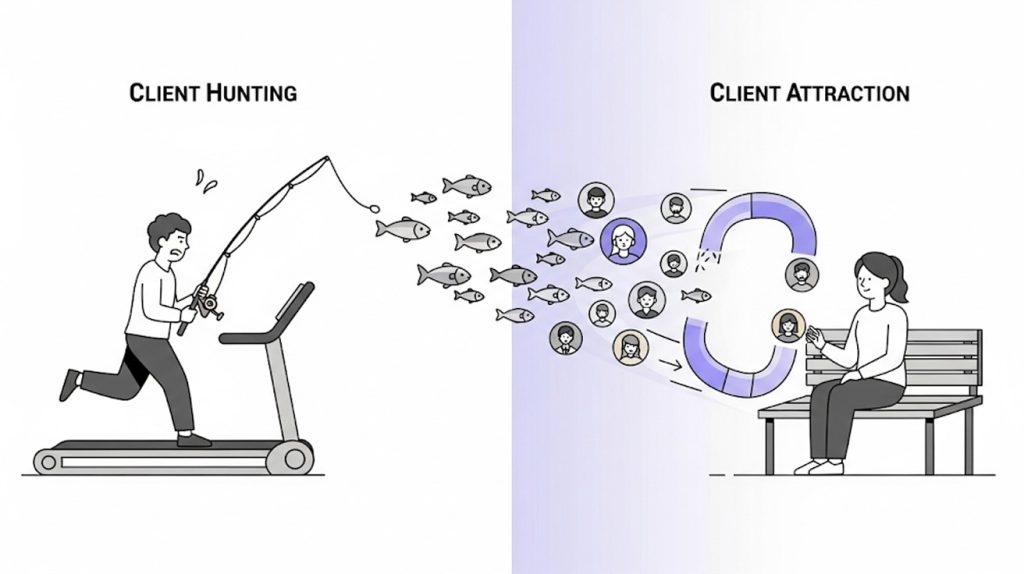
This article isn’t about hoping for a client to magically land in your inbox. It’s about shifting your mindset from client hunting to client attraction. We’re going to break down five proven, actionable strategies you can use right now to stop chasing clients and start getting them to come to you.
These are the same strategies used by top coaches, consultants, and freelancers to build a consistent stream of leads and a thriving business. Ready to stop guessing and start growing? Let’s dive in.
1. Go Where Your Clients Are Looking
Think of your ideal client. Where do they hang out online when they have a problem? Are they scrolling through Instagram, or are they on a platform like LinkedIn, looking for professional solutions? Are they asking for recommendations in a Facebook Group, or are they scouring industry-specific forums for answers?
The first and most crucial step to finding clients is to stop shouting into the void and start showing up in the right rooms. Your perfect client isn’t just waiting for you to find them; they’re actively searching for a solution, and your job is to be the expert they discover.
Here’s how to do it:
- LinkedIn is Your Playground: If you offer B2B (business-to-business) services, LinkedIn is your best friend.Optimize your profile to act as a landing page for your services. Join relevant groups where your target clients and decision-makers are active. Don’t just lurk; provide value by answering questions, sharing insights, and participating in discussions. This positions you as an expert and builds credibility naturally.
- Facebook Groups Are a Goldmine: Facebook Groups are powerful for both B2B and B2C (business-to-consumer) services. Find groups where your ideal clients are asking questions and seeking advice. Be a valuable contributor. Instead of self-promoting, offer genuine, helpful advice. When you consistently provide free value, people will naturally be curious about who you are and what you do. This is the foundation of the “attraction” strategy.
- Industry-Specific Forums & Communities: Depending on your niche, there might be dedicated forums, Reddit communities, or online hubs where your clients gather. Find these spaces and become a helpful member. Whether you’re a web designer in a community for small business owners or a copywriter in a forum for coaches, your goal is to be a resource, not a salesperson.
Remember, the goal is not to find a client immediately, but to build trust and authority. When you consistently show up and provide value where your audience is already looking, you become a credible resource. This makes you the logical choice when they are ready to buy.
2. Hit Up Existing Clients
You’re so focused on finding new clients that you often overlook the most valuable asset you already have: your past and present clients. This is one of the most effective, yet underutilized, strategies for generating new business. Why? Because your best new client is often a referral from a happy old one.
Think about it:
- Trust is already established: They’ve worked with you, they know your expertise, and they trust your process.
- The sales cycle is shorter: A client who comes to you through a referral is already pre-qualified and often ready to move forward.
- They’re a great source for testimonials and case studies: These are your most powerful marketing materials.
So, how do you turn this into a proactive strategy?
Ask for Testimonials and Reviews
This should be a standard part of your process. After every project or a certain milestone, send a quick email asking for a testimonial. Make it easy for them. Provide a few questions to guide their response, such as:
- “What was your main problem before we started working together?”
- “What specific results did you get from our work?”
- “What was the best part about working with me?”
These testimonials are gold. Feature them prominently on your website, your social media, and in your proposals.
Create a Referral System
Don’t just wait for referrals to happen—incentivize them. It doesn’t have to be a complicated system. A simple gesture like a small gift, a thank you note, or even a percentage off their next service can motivate past clients to sing your praises. A referral system turns your satisfied customers into an extension of your sales team.
Reactivate Past Relationships
Reach out to past clients you haven’t worked with in a while. A simple “hello” email can be surprisingly effective. You might find that they have new needs, or they might be willing to refer you to someone who does. The goal is not to sell them something immediately, but to remind them that you’re still an active, valuable resource in their network.
Nurturing your existing client base is a no-brainer. It’s a low-cost, high-return strategy that’s built on the most powerful marketing tool there is: genuine relationships.
3. Make a Giveaway for an Exchange
Have you ever seen an Instagram post that says, “Comment ‘GUIDE’ to get my free checklist”? That’s not just a clever trick to boost comments; it’s a brilliant lead-generation strategy. It’s the modern version of a giveaway, where you offer a valuable resource in exchange for a potential client’s information and attention. This is often called a lead magnet or, as we like to call it, the “ethical bribe.”
Why does this work so well?
Because you’re not just asking someone to follow you. You’re giving them a tangible, valuable solution to a problem they have right now. This is a powerful way to pre-qualify potential clients. If someone downloads your free guide on “Instagram Bio Hacks,” you know they are actively interested in your expertise and are a potential client for your social media management or consulting services.
The Goal: Build an Email List
Social media platforms are great for visibility, but they are rented land. Your email list is a piece of digital real estate you own. When you use a giveaway, your main goal is to get that email address. This allows you to build a direct line of communication with people who have already shown interest in what you do.
Examples of High-Value Giveaways:
- Checklists: Simple, easy-to-digest guides on how to do something.
- Templates: A plug-and-play solution (e.g., a social media content calendar template).
- Exclusive Guides or eBooks: A deep dive into a specific topic that solves a pain point.
- Free Masterclasses or Webinars: An opportunity to teach your audience and build trust live.
The key to a successful giveaway is that it must be incredibly valuable and a no-brainer for your audience. It should solve a real problem they are facing and be a taste of the expertise you provide in your paid services.
By using this strategy, you stop relying on the algorithm to connect you with potential clients. Instead, you create a system that attracts, nurtures, and converts them into a loyal audience and, eventually, paying clients.
4. Document Everything on Social Media
You’ve heard that you need to “create content” for social media, but what if there was an easier, more authentic way to do it? The best lead-generation strategy isn’t about creating perfect, polished content. It’s about documenting.
What’s the difference?
- Creating means you sit down and try to come up with something from scratch—a perfect quote graphic, a perfectly scripted Reel. It can feel like a lot of pressure and often leads to writer’s block.
- Documenting means you simply capture and share what you’re already doing. You’re not inventing a story; you’re telling the one that’s already happening.
Think about it: Your work, your process, and your results are the most powerful marketing tools you have. When you start documenting, you become your own real-time case study.
How to Document Your Work
This isn’t just about sharing a photo of your desk. It’s about sharing the a-ha moments, the wins, and even the challenges of your day-to-day work.
- Share the Behind-the-Scenes: Show a screenshot of a project you’re working on. Record a quick video explaining your thought process for a client’s strategy. This gives your audience a peek behind the curtain and makes you more relatable and trustworthy.
- Highlight Client Wins: Did a client get a great result from your work? Don’t just post a testimonial. Turn it into a mini case study. Share a screenshot of their result and explain the strategy you used to get there. This is irrefutable social proof that your services work.
- Tell Stories: Talk about a problem you just solved for a client. Share a short story about a recent breakthrough. Storytelling makes your expertise tangible and demonstrates the value you provide in a real-world context.
By documenting, you’re not just sharing content; you’re building a powerful personal brand. You’re showing your expertise and your process in a way that feels authentic and human.
This builds a deep level of trust with your audience, positioning you not just as a service provider, but as a genuine expert they want to work with. Your personal brand becomes your most powerful lead magnet, attracting clients who already know, like, and trust you.
5. Update Your Keywords So They Find You
You’ve heard of keywords for SEO, but what do they have to do with you as a service provider? Everything. Think of keywords as the specific language your ideal clients use when they’re looking for someone just like you. Your job isn’t to hope they stumble upon your website or social media profile; it’s to use their language so they can find you instantly.
This is the key to going from “chasing” to “attracting.”
Your Keywords Are Your Digital Magnet
Everywhere you have a digital presence—your website, your LinkedIn headline, your Instagram bio, your blog posts—is an opportunity to use these keywords. When someone searches for a solution you provide, you want to be the answer that pops up.
For example:
- Instead of a vague title like: “Freelance Marketing Consultant”
- Try something specific like: “Social Media Marketing Consultant for E-commerce Brands”
The second option is packed with keywords that a potential client would actually use in a search. It tells them exactly who you are, what you do, and who you do it for, all in one line.
A Step-by-Step Guide to Keyword Research
You don’t need a fancy tool to start. Here’s a simple process to find your perfect keywords:
- Listen to Your Clients: What words and phrases do your current clients use to describe their problems? What questions do they ask you? What terms do they use to describe your services? Write them all down.
- Spy on Your Competitors: Look at the headlines, bios, and website copy of other successful service providers in your niche. What keywords are they using? This isn’t about copying, but about understanding the language of your industry.
- Search Yourself: Go to Google and search for the service you provide. What phrases and questions come up in the search results and in the “People Also Ask” section? These are the exact terms your audience is searching for.
Once you’ve compiled a list of your most powerful keywords, start integrating them naturally into your digital presence. Update your social media bios, the headlines on your website, and the titles of your blog posts. This simple change makes a huge difference, transforming your online presence from a static page into a powerful lead-generating tool.
Remember, your ideal clients are actively looking for a solution. By speaking their language, you make it easy for them to find you and hire you.
Conclusion: Stop Chasing and Start Attracting
You’ve just learned five proven strategies that go far beyond “hope and pray” when it comes to finding clients. The key takeaway here is to shift your focus from actively chasing down new business to building a system that attracts it to you.
Remember, a successful service-based business isn’t built on a single cold call or a random message to a stranger. It’s built on a foundation of trust, authority, and genuine connection.
Here’s your action plan:
- Stop lurking, start participating: Go to the communities where your ideal clients are and become a valuable resource.
- Turn your past into profit: Proactively ask for testimonials and leverage your existing relationships.
- Build your own list: Use a high-value giveaway to attract potential clients and build your most valuable asset: your email list.
- Document your journey: Show your audience the real-world value you provide by sharing your process and client wins.
- Speak their language: Update your keywords across all your platforms to make it easy for clients to find you when they need you most.
By implementing these strategies, you’ll stop the exhausting cycle of client hunting and start building a powerful funnel that brings qualified leads directly to your inbox. The business you’ve always wanted is within reach. Now, it’s time to go and get it.